How do you actually know whether the wheels you are looking at online will look good on your particular car? KERATECH has made that question the centrepiece of their new app, KERATECH WHEELS, which combines the company's existing webshop with AI, visualisation and a personal digital garage.
Rather than simply moving the webshop into an app, KERATECH has rethought the digital buying journey. The app is meant to be a new way into KERATECH, where customers can find inspiration, get help choosing the right products and see the result on their own car before deciding to buy.
KERATECH sells tyres and wheels online and already had a well-functioning webshop with products, product data and features such as finding tyres and wheels from a car's number plate.
The idea of an app really took shape when KERATECH filled in the form for a free app preview at starti.app.
For KERATECH, the preview was the starting shot for a bigger ambition. The app was not just going to give customers access to the existing webshop from their phones. It was going to create a different and more engaging way of finding and buying wheels.
starti.app info
The purpose of the app preview is to give companies considering an app a visual impression of how their existing web solution can form the foundation of an app for iOS and Android - before they decide to move ahead with an actual project.
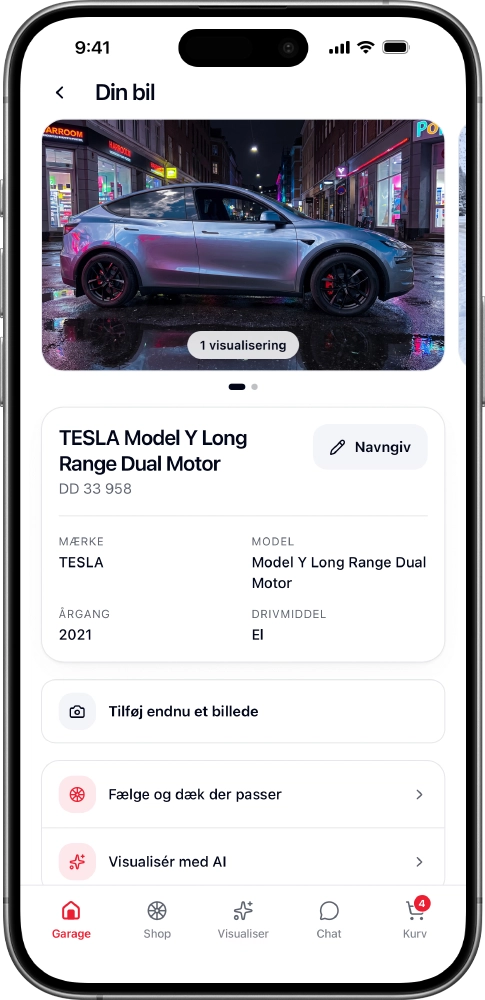
When a user signs up in KERATECH WHEELS, they get their own digital garage.
Here the user can add one or more cars using the number plate. KERATECH's existing system identifies the car and therefore also knows which tyres and wheels fit that specific model.
This means the user does not have to start their buying journey by navigating a large product catalogue. Instead, the app starts from something far more relevant: the user's own car.
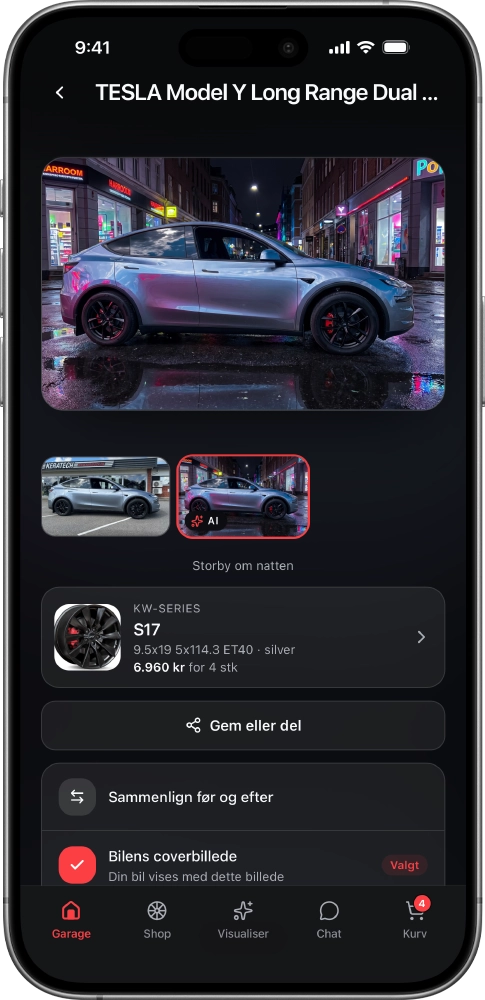
Once the car is in the garage, the user can see the wheels that fit that particular car, save pictures and visualisations of it and come back to them later. That makes the experience personal from the start and, at the same time, reduces the number of irrelevant products the customer has to consider.
The central element of the app is an AI-based visualisation feature.
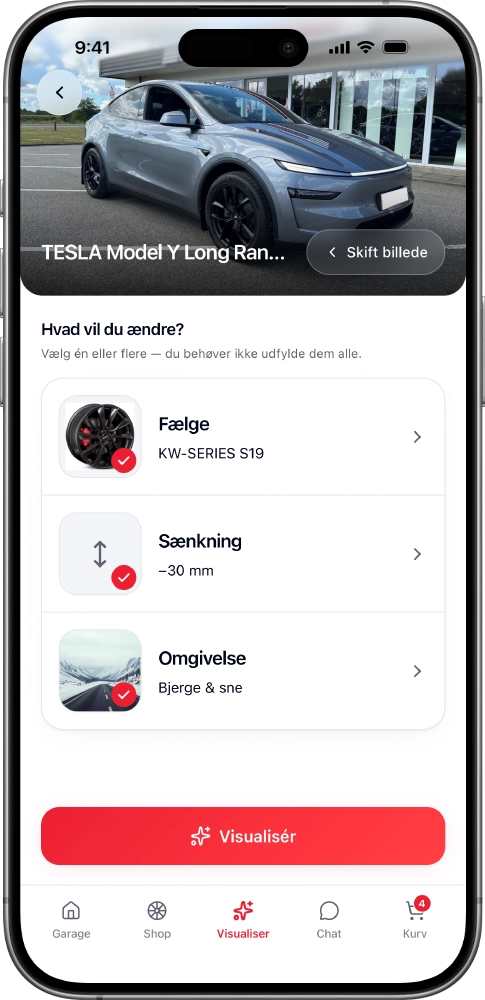
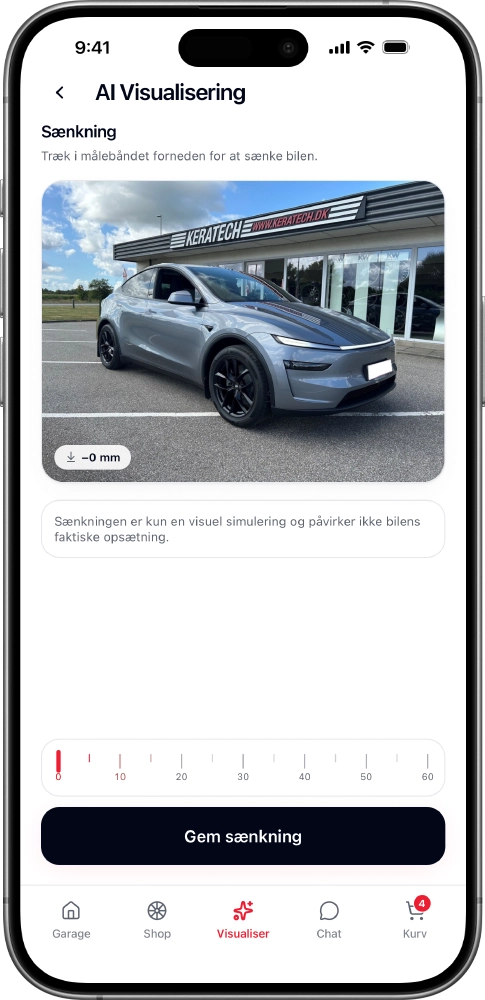
The user takes a picture of their car directly with the phone's camera and then picks the wheels to try on the car. The user can also choose between different surroundings - for example a snowy landscape or a beach road at sunset - and choose whether the car should be visualised lowered.
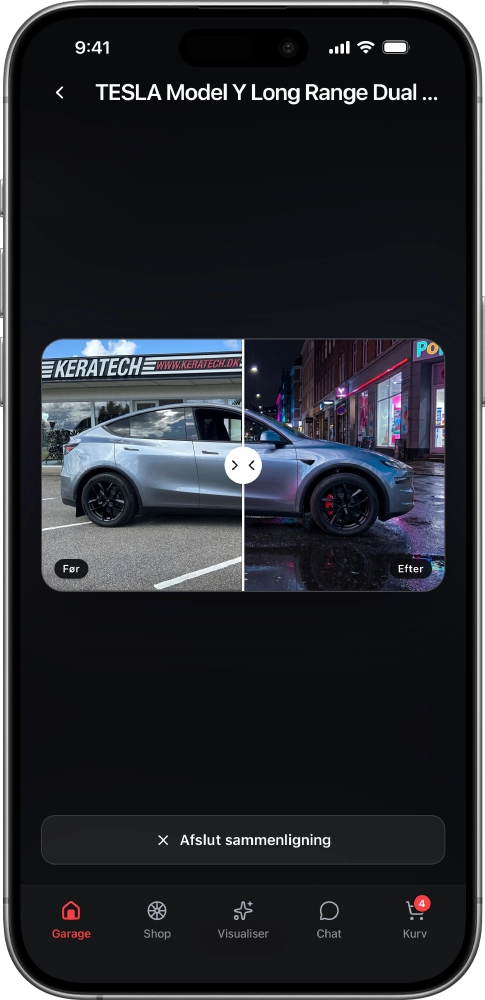
Based on those choices, AI generates a new image of the user's own car with the chosen wheels and surroundings. When the visualisation is ready, the user can use a slider to switch between the original photo and the AI-generated result and compare the car before and after.
That makes a product that can otherwise be hard to imagine online far more concrete. Instead of seeing a wheel in isolation on a product photo, the customer gets an idea of how it will look on the car it is actually going to be fitted to.


Pick wheels and surroundings, adjust the lowering, and let AI generate the image - three steps from photo to visualisation.
Pick wheels and surroundings
Lowered or standard
AI visualisation
The visualisations are not just made for fun. They are designed directly into the buying journey.
If the customer is happy with the result, they can go straight from the visualisation to the chosen wheels and add them to the basket.
If the customer is not quite sure yet, the picture can be shared with others. That might be a partner or a friend whose second opinion you want before ordering.
The sharing feature has another dimension too. For many car enthusiasts, the car is more than just transport. Once you have a great visualisation of your car with new wheels in a stunning setting, the picture can be saved and shared with others or on social media. In that way, choosing a product becomes an experience that potentially reaches beyond the purchase itself.
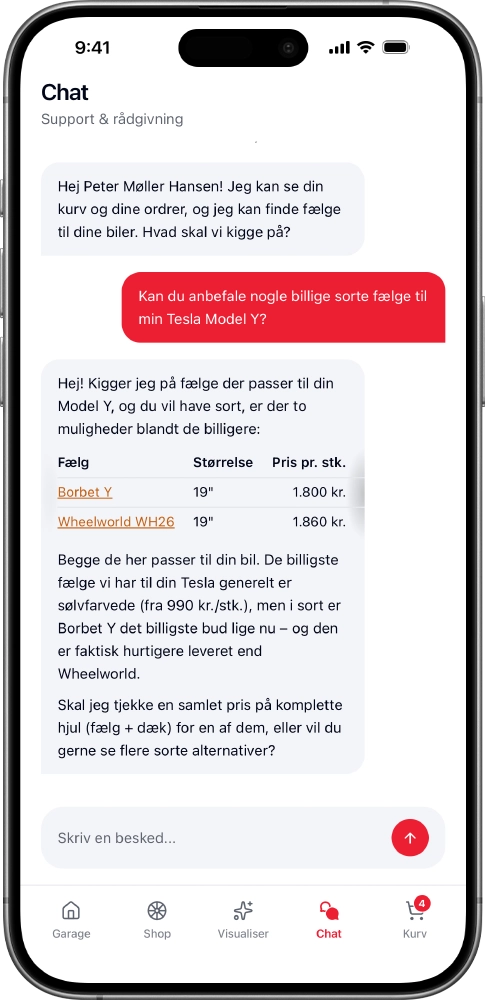
AI also plays another role in the app. KERATECH WHEELS has had an AI chat integrated that can help the user with questions about the company's products and range.
If you have a particular car and a particular budget, for example, you can ask the AI for suggestions for relevant wheels. The user can get help and inspiration along the way without first needing in-depth knowledge of tyres, wheels and the many options.
The AI chat helps with the first question - based on car, budget and range.
The visualisation helps with the next one - on a photo of the customer's own car.
Once the customer has found the answer, the chosen wheels are one tap from the basket.
Although the app differs from KERATECH's website in many ways, the company's existing webshop is still the foundation.
The products and a number of the existing features are reused in the app. KERATECH's web developers have made data and functionality available through an API that starti.app can communicate with. That means KERATECH does not have to build and maintain a separate product universe just for the app.
On top of the existing foundation, a new user experience has been developed specifically for the app, including a new design, the digital garage, the AI visualisations and the AI chat. Holion is responsible for the design and development of the app using starti.app technology.
The result is therefore not a 1:1 copy of the webshop in app format. It is a solution where existing technology and content are reused, while the investment can be focused on the features and the user experience that give customers something extra in the app.
From KERATECH ordering their final app until it was ready to download in both the App Store and Google Play took three weeks.
An important reason for the short path from idea to finished app was that KERATECH did not have to start from scratch. The webshop, the products and central parts of the existing functionality were already in place. KERATECH's web developers could therefore focus on making the necessary data and features available, while Holion focused on the app experience and the new features that were built on top.
For KERATECH, the app has therefore not been about replacing an existing webshop. It is about getting more out of the digital foundation the company already has - and using the app, AI and the possibilities of the phone to create a new way into the business and a buying journey that is both easier and more fun for finding the right wheels.
For KERATECH, it is wheels. For other companies, it may be something completely different.
What many products have in common is that the customer can find it hard to imagine the result from a traditional product photo. How does the wheel look on my car? Do the new windows suit my house? How will that colour work on my wall?
This is where AI opens up new possibilities in the digital buying journey. Instead of only showing the customer the product, you can to a greater extent show the product in the customer's own context.
That is exactly what KERATECH does with the app. They start from something the customer already has - the car - and use it to make product search, advice and visualisation personal. Only then comes the purchase itself.
The same way of thinking can be applied far more broadly. An app does not have to be just a new channel for the same product catalogue. It can be an opportunity to rethink the parts of the customer journey where customers lack inspiration, advice or help to make the right decision.
KERATECH WHEELS began with a free app preview based on KERATECH's existing webshop. If you also have a website, webshop or web platform that could form the foundation of an app, we are happy to show you what it could look like - and what possibilities an app can open up for your business.
